I used to think I could multitask. Back in the 6th grade or so, I remember "simultaneously"drawing, watching TV, and doing homework. Of course, I really wasn't doing all that at once, but I was certainly trying. All the work got done in the end, so I figured I could keep on "multitasking." I usually kept it down to just watching tv and doing homework, but I did it all through high school.
Recently, I've gotten about half way to kicking the habit. Now that all my work has to happen on the computer (save the sketching parts), my workstation is the same as a huge source of entertainment. The Internet, Netflix, and tons of articles are just one 3-finger swipe and two clicks away. It's so easy to get distracted by a thought and end up on browsing the internet. Sometimes I'll even run a Netflix show I know well, like Bob's Burgers or Archer in the background and just listen to the show as I work. I say that I need the "background noise" to work, but that's not really the case. When I work in the Campus Life Office, I often work in silence, or just with music, and that's when I'm at my most productive.
Of course, these are terrible habits that I need to break. One of the books recommended to me: 99u's "Manage Your Day-to-Day," has a whole section on focus and breaking what psychologist Christian Jarrett calls the "multitasking myth." His article is about the way we lose our flow when we lose our focus and multitask, since we aren't really doing two things at once, but bouncing quickly back and forth between two things. Any time we turn our attention away from the task at hand, we fall down a "rabbit hole" of distraction.
The biggest issue for me lies in the fact that I need to use a computer to do a good portion of my work. "Even if you have cast iron willpower," Jarrett writes, "the mere fact that the internet is lying in wait on your computer takes a toll on your work performance." We have to do our work on machines that are the gateway to distractions, it's likely we'll end up there at some point.
So what am I doing to fix this? Well, for starters, I've taken to shutting off the wifi on my computer when I have to get work done. This doesn't alway work, since I do need the internet for some of my work, but it does help me to focus. I've also begun weaning myself off of Netflix with music and podcasts (particularly This American Life, an NPR podcast). Since there are no visuals, I'm not nearly as tempted to change my focus to it fully, I can just half-listen to it as I work. I'm a work in progress, but I'm definitely improving.
Friday, February 21, 2014

Friday, February 7, 2014
Logo - First Drafts
 |
| We have a winner! |
So I took him to the whiteboard for a little work:
 |
| excuse the camera quality; it's an old iPod I'm using... gotta get a camera |
Wednesday, February 5, 2014
Errands Usability Report
It was a lot easier to get people to do an app walkthrough than I had thought. Originally, I thought I was going to walk into the radio station (my go-to place for finding people, since I'm the General Manager and I command some respect there :P), ask for some people to run through the app for me, get a few blank stares and lame excuses, and then have to try somewhere else.
Instead, I got three willing participants almost immediately. I couldn't have gotten a better mix if I had chosen people specifically, either. There were two who use to-do lists, one who doesn't; mac and pc users, and tech users of different levels.
Honestly, the hardest part of the process was keeping up with my users. They tore through the app, for the most part, and I didn't want to ask them to slow down (that would muddy the results a bit, in my opinion). Getting them to explain outloud to me what they were doing definitely helped, but I'm sure I missed some data. Next time, I need a video!


Personas Revised
After some feedback on my initial personas, I found out I had a lot of work ahead of me. I went back to the research board (is that a thing?), and dug up a few more articles about the creation of personas, specifically what they were supposed to entail. This site gave me some good insights, especially in the humanization department. The biggest issue for me was that I hadn't fleshed out my persona enough... she was just a collection of vague user stats in the shape of a hypothetical girl named Wendy. Sure, she had a background, but I hadn't deemed it necessary to delve too far into her life. She was just an acquaintance. So I decided to use a technique I learned from a writing book back when I was so keen on writing fiction in high school.
I took her out to dinner, and we hit it off. She told me a lot about her life: growing up the youngest of three, the car accident that wrecked her leg in Sophomore year, her resolve to become a nurse after her time in the hospital. She was very open about her time in college, and how she partied so hard her first year that she nearly flunked out. She managed to turn her grades around after, but at the expense of her social life.
I liked her, but in the end, it didn't work out; she had too much to do between her work and education (and so do I, I suppose), and it turned out she was older than I thought (her age went up by three years since the last time I checked) but I had learned everything I needed. I reworked her, and this is the result:

I took her out to dinner, and we hit it off. She told me a lot about her life: growing up the youngest of three, the car accident that wrecked her leg in Sophomore year, her resolve to become a nurse after her time in the hospital. She was very open about her time in college, and how she partied so hard her first year that she nearly flunked out. She managed to turn her grades around after, but at the expense of her social life.
I liked her, but in the end, it didn't work out; she had too much to do between her work and education (and so do I, I suppose), and it turned out she was older than I thought (her age went up by three years since the last time I checked) but I had learned everything I needed. I reworked her, and this is the result:
Friday, January 31, 2014
Sketching Time!
I love sketching. I've always been a doodler; quite a few of my notebooks from high school are more doodle than notes! That's part of the reason I love being in a design program... the teachers rarely yell at you for doodling :P
So I started on my logo sketches, first on the white board wall stickers I have in my room:

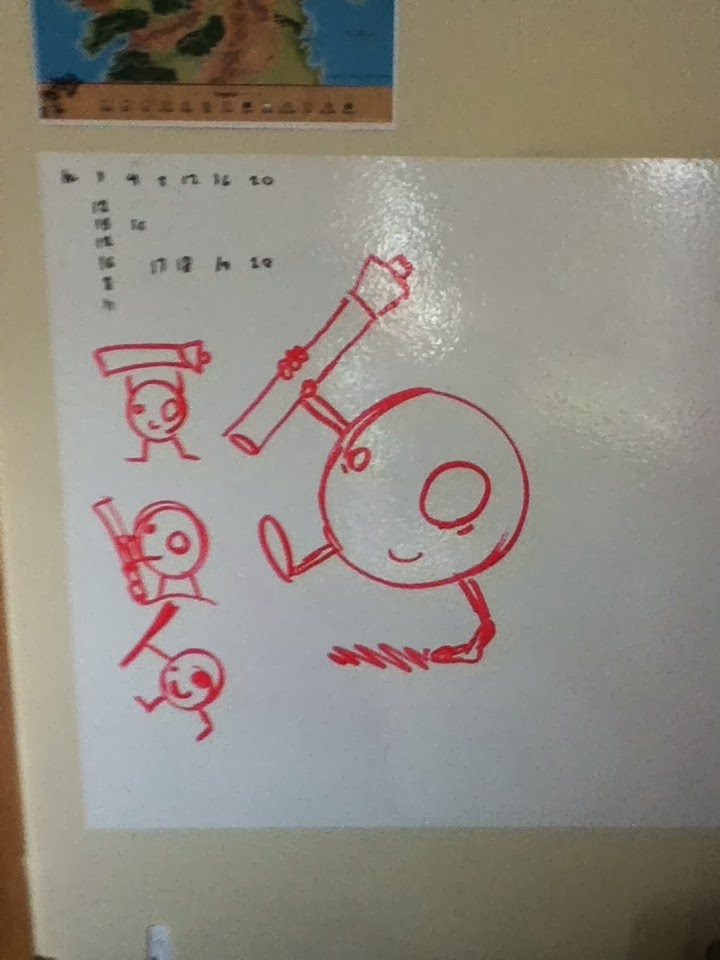



So I started on my logo sketches, first on the white board wall stickers I have in my room:
The blog title sort of hints towards my love of whiteboards, but I've found that they are amazingly helpful. I realized it when Ira Fey, possibly the best Game Design teacher, held Skype interviews with professionals in the field. Four of the five designers had huge whiteboards in their rooms (yeah, I kept track), so naturally, I took notice. Having a huge writing surface readily available has come in handy for me more than once, I highly recommend it. If you need to be convinced, I'd suggest you read this article.
But I digress, back to the logo sketches:
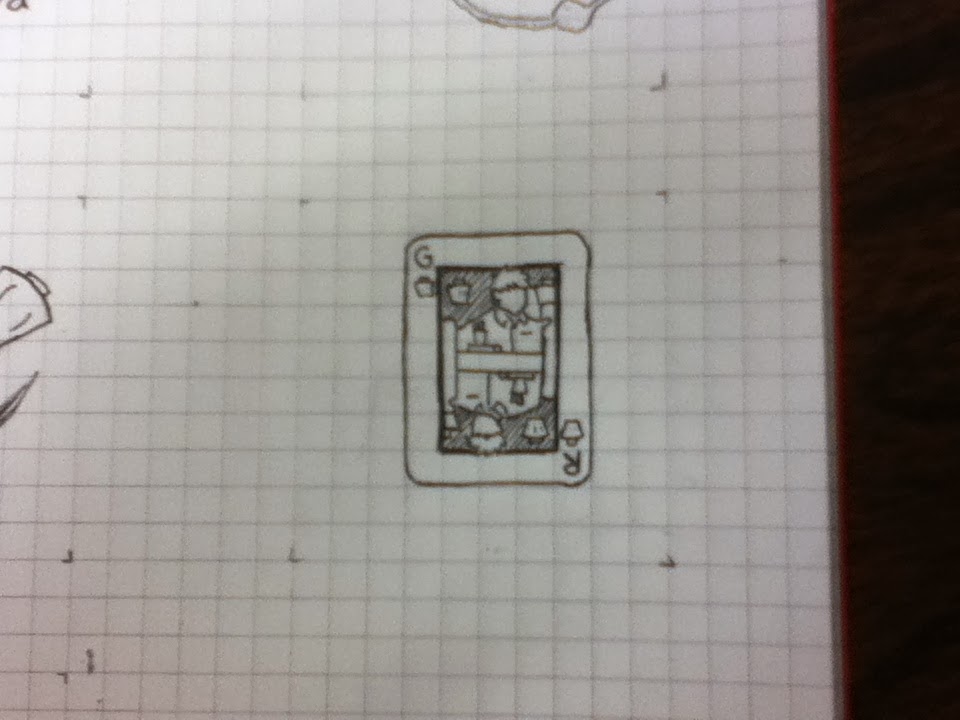
After the concepting, I put ink to paper in the most painstaking process ever! Pens bug me out, since once it's on paper, that's it. Not pictured are the three pages of mistakes.
Mindmapping
I've been mindmapping for years without knowing it. I first learned the skill in Game Design, when we were laying out ideas for our first big game, "Awesome Man and the Maze of Doom." Now, we called it brainstorming, but it was a very similar concept. A big, blank whiteboard and some markers, and we plotted out the whole concept over the course of a few days (with minimal unintentional erasures), and that helped us to cement what we were doing.
Fast forward three years (God, has it been that long?) and I'm beginning to think about putting together my portfolio. Pattie Belle introduced the concept of the mindmap to us a diagram form of the brainstorm, a physical bit of proof of ideas. Along with providing us with plenty of examples of mindmaps, she introduced us to the concept of creating one to keep track of project ideas. An extended brainstorm, you might say, as you keep it going over a long period of time.
Now, I wanted to create my mind map on a whiteboard in one of the classrooms, but fate intervened in the form of an eraser while I wasn't there (to be fair, I left for more than an hour). So, until I can get in front of a whiteboard unimpeded, I turned to NovaMind to create the Mindmap on computer.

Such as this one! (Update 2/7/14)
And there's a lot of restructuring that needs to occur...

Fast forward three years (God, has it been that long?) and I'm beginning to think about putting together my portfolio. Pattie Belle introduced the concept of the mindmap to us a diagram form of the brainstorm, a physical bit of proof of ideas. Along with providing us with plenty of examples of mindmaps, she introduced us to the concept of creating one to keep track of project ideas. An extended brainstorm, you might say, as you keep it going over a long period of time.
Now, I wanted to create my mind map on a whiteboard in one of the classrooms, but fate intervened in the form of an eraser while I wasn't there (to be fair, I left for more than an hour). So, until I can get in front of a whiteboard unimpeded, I turned to NovaMind to create the Mindmap on computer.
This is by no means finished; as a matter of fact it's only beginning. This article from Mind Tools explains that, unlike the brainstorm, the mind map continues on for the life of the project, always expanding.
Expect to see plenty more (and better looking versions) of these!Such as this one! (Update 2/7/14)
And there's a lot of restructuring that needs to occur...
Tuesday, January 28, 2014
Creating a Person
I've created quite a few people before. As an amateur adventure writer, I've fleshed out my fair share of characters, with everything from personality to goals to conversational quirks.
That being said, none of that prepared me for creating a user persona. I started out the process thinking that I was just going to be creating another character; albeit a character that exist in the real world and was interested in mobile apps. I figured I could give her a short backstory, a little moral conflict between her family and her dreams. Maybe she could have a job she didn't like, but it helped her support her busy family.
When I create a character, I'm creating from scratch. The only limits are the needs of the adventure, and even those I can modify to fit a more interesting character.
I can shape the character to my needs, and usually that means making the character as unique as possible.
UNDER HUGE REWRITE!!!!!! check back tonight
That being said, none of that prepared me for creating a user persona. I started out the process thinking that I was just going to be creating another character; albeit a character that exist in the real world and was interested in mobile apps. I figured I could give her a short backstory, a little moral conflict between her family and her dreams. Maybe she could have a job she didn't like, but it helped her support her busy family.
When I create a character, I'm creating from scratch. The only limits are the needs of the adventure, and even those I can modify to fit a more interesting character.
I can shape the character to my needs, and usually that means making the character as unique as possible.
UNDER HUGE REWRITE!!!!!! check back tonight
Subscribe to:
Posts (Atom)